

Suggested featured image / thumbnail.
TL;DR
Short version: four numbers decide whether a niche is worth entering, and the one most people skip is the last, because it is the only one that cannot be looked up. |
The question a niche has to answer is never whether people buy t-shirts. They demonstrably do. It is whether the specific slice you are about to spend a month designing for is currently reachable, and that is a question with numbers attached rather than a matter of taste.
The full research process, including the tooling for each check, is set out in this guide to finding Amazon Merch on Demand niches. Four thresholds do most of the work, and they are worth running in order, because the cheap ones disqualify most candidates before the expensive one is needed.
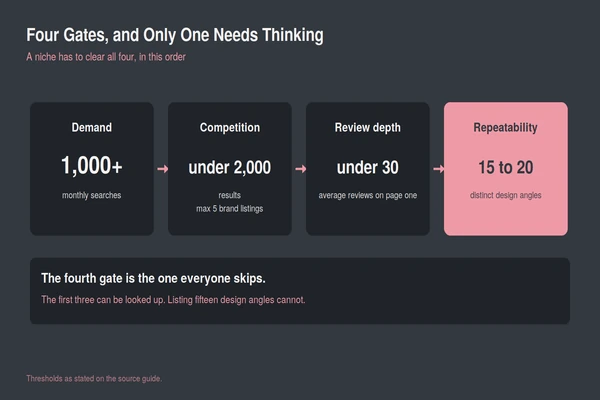
Three of these you can look up. The fourth is the one that decides it.
Number One: A Thousand Searches
A thousand monthly searches is the floor.
Below it, even total dominance of the niche does not produce a business. Capture every buyer in a 300-search niche and you have a hobby with good conversion. The threshold exists because print-on-demand economics require volume across many designs rather than depth on a few, and a niche that cannot supply the volume is not underserved, it is small.
The trap here is the reverse. Sellers find a 40,000-search term, get excited, and enter a category where every result on page one belongs to someone with a marketing budget. Demand is necessary and it is not sufficient, which is why the second number exists.
Number Two: Under Two Thousand Results
Under 2,000 competing results is a low barrier. Beyond that you are not entering a niche, you are joining a queue.
Pair it with a second check that is more informative than the raw count: how many listings on the first page belong to established brands. More than five and the page is effectively spoken for, regardless of what the total result count says.
The two checks can disagree, and when they do the brand count wins. A niche with 1,200 results where a licensed property holds seven of the top ten clears the numeric ceiling and is still closed to you. Treat 2,000 as the screen that gets you to the shortlist, and brand density as the one that decides what comes off it.
That ordering matters because result count is easy to measure and brand density is not, so sellers measure the easy one and act on it.
Number Three: Read the Reviews, Not the Listings
Review depth is the saturation signal that actually predicts your outcome, because it measures how long the incumbents have been converting rather than how many of them exist.
Under 30 average reviews. Green. The category is young or the incumbents are not selling much, and either is an opening.
30 to 80. Contested. Entry is possible with a genuinely better design or a sharper angle, and it will take longer than you want.
Above 80. Closed for practical purposes. Not because you cannot list, but because a new listing with zero reviews sitting beside listings with a hundred converts at a rate that will not fund the effort.
Number Four: Fifteen Angles or Walk Away
This is the check nobody runs, and it is the one that separates a niche from a t-shirt idea.
Before you design anything, write down 15 to 20 distinct design angles the niche supports. Different jokes, different occasions, different audience slices, different visual treatments. If you get to eight and stall, you have found a design, and a design is a lottery ticket rather than a strategy.
The reason this matters is arithmetic. Print-on-demand returns come from a portfolio where a small number of designs carry the rest. A niche supporting five designs gives you five chances. One supporting twenty gives you twenty, at the same research cost, using the same audience understanding, with the same keyword set already built.
The Price Band the Niche Has to Support
Check what the existing listings charge before you commit, because it tells you what the ceiling is.
A niche where everything sells at $15.99 is a niche with razor-thin royalties, and no amount of design quality moves a market price. What you want is a category already transacting in the $18.99 to $24.99 range, which indicates buyers who are choosing on something other than price.
It is worth knowing how much room there is up there. The average US consumer unit spent $2,001 on apparel and services in 2024, about 2.5% of total spending, according to the Bureau of Labor Statistics Consumer Expenditure Survey released in December 2025. That was down 2.0% on 2023, when the figure was $2,041.
A shrinking pool split across every garment a household buys is not a reason to avoid the category. It is a reason to be selective inside it, because a seller is competing for a share of a budget that is not expanding. A niche transacting at $24.99 is worth more than one transacting at $15.99 with twice the traffic, and that gap widens rather than narrows when overall spend is flat.
This one takes about ninety seconds, and it is worth running first, before any of the four, precisely because it is that cheap.
Build the Calendar Backwards
Two structural rules on the portfolio, once you have picked the niches.
Split roughly 70% evergreen and 30% seasonal. Evergreen designs earn quietly all year and fund the experiments. Seasonal designs spike and then stop, and a portfolio weighted toward them produces an income that arrives in two months and disappears for ten.
Upload seasonal work 6 to 8 weeks before the holiday. Not because the buyers are early, but because indexing is. A design published two weeks before Christmas has not had time to accumulate the signals that get it shown, and it will be competing against listings that have been indexed since October.
The practical consequence is that the seasonal calendar is a production schedule, not a marketing one, and it runs a quarter ahead of the retail calendar.
Score It Before You Draw It
Score each check rather than eyeballing the niche as a whole, and require it to pass all four rather than to average well across them.
That second part is the discipline. A niche with spectacular demand and eighty-review incumbents does not average out to viable, it fails on review depth, and a scoring system that lets a strong number rescue a weak one will hand you exactly the niches you should have walked away from.
The point of writing the scores down is not precision. It is that a form forces you to fill in the box you would otherwise skip, and the box everyone skips is the fifteen-angles test, because it is the only one that requires thinking rather than looking something up.
Run it on the niche you are currently most excited about. If it clears, you have lost twenty minutes. If it does not, you have saved a month.